Pre-Seed Β· Q4 2026
ΰ€¨ΰ€Ύΰ€΅ΰ€Ώΰ€•ΰ₯ΰ€Έΰ€°
Rebuilding this scene from raw points, the way Navixar rebuilds Indian streets

Every robotaxi company in the world skipped India.
Navixar is India's answer to the robotaxi revolution.

India-Native VLA-Powered Simulation-First

The world's robotaxi players have raised $21B+ and now operate on every continent but one. India, the world's 3rd largest auto market, still has zero. Navixar exists to be first.

RoundPre-Seed
InstrumentSAFE
Current Raiseβ‚Ή00 Cr
Target CloseQ4 2026
Munish Raj Β· Founder & CEO Β· munish02@gmail.com Β· Strictly Confidential
Scroll to explore
01The Opportunity

$21.4B Raised. Not One In India.

The world is racing to build robotaxis. Waymo, Zoox, Waabi, Wayve, Baidu Apollo, WeRide, Pony.ai, Momenta: every major geography already has a credible autonomous player. India, the world's 3rd largest auto market, has none.
USA / Canada UK / Europe China India: The Gap
USA / Canada
Waymo (Alphabet)
$160B+ Valuation
3,000+ vehicles, ~500K paid rides/week across 10 US cities. Zero India presence.
Zoox (Amazon)
$1.4B raised Β· production-intent robotaxi
Canada
Waabi
$750M Β· Uber-backed
Canadian-founded, US-focused. North American highway AV. No Asia operations.
UK / Europe
Wayve
$1.3B Β· NVIDIA & Microsoft
Embodied AI approach. UK-focused testing. Emerging market expansion not on roadmap.
China
Baidu Apollo
$1.8B Β· 17M rides
China-specific. Structured road assumptions. No India presence.
WeRide  Β·  $1.44B Nasdaq
Momenta  Β·  $1.5B GM/Benz
Pony.ai  Β·  $1.22B Nasdaq
India
No Credible AV Player
β‚Ή0 Deployed
3M+ rides/day. Zero autonomous deployments. This is the gap Navixar was built to close.
Sources: Crunchbase Q1 2026 AV Sector Report Β· TechCrunch Β· Waymo/NHTSA filings Dec 2025 Β· Zoox 2026 Β· Waabi Jan 2026 Β· Wayve Series D 2026
ΰ€ͺΰ₯ΰ€°ΰ€Άΰ₯ΰ€¨
02The Question

$21B Everywhere Else. Zero In India. Why?

It's not because nobody noticed 1.4 billion people. Before we show you our thesis, take a guess: what are the two hardest technical problems in bringing autonomy to India? Pick two.
Select your two answers to unlock our thesis
ΰ€Έΰ€Ώΰ€¦ΰ₯ΰ€§ΰ€Ύΰ€‚ΰ€€
03Our Thesis

Algorithms (AI Models) are becoming more accessible. Data and Validation are not.

Open-source stacks, foundation driving policies, and VLA architectures are converging fast, making the tech table stakes. What nobody has is Indian data, an India Compliant Simulator, and a real path to deploy in Indian traffic. That's the actual bottleneck, and it's the whole company.
Pillar 01 Β· Data
Collect Data No One Else Has

Drone capture, gamified crowdsourcing, and bulk dashcam acquisition are three ways to get Indian driving data fast, without waiting years on a sensor fleet.

Data Moat
Pillar 02 Β· Simulation
Validate At A Scale Roads Can't Match

Gaussian-splat reconstructions of real Indian streets let us stress-test millions of scenarios before a single vehicle drives one of them.

Simulation Moat
Pillar 03 Β· Deployment
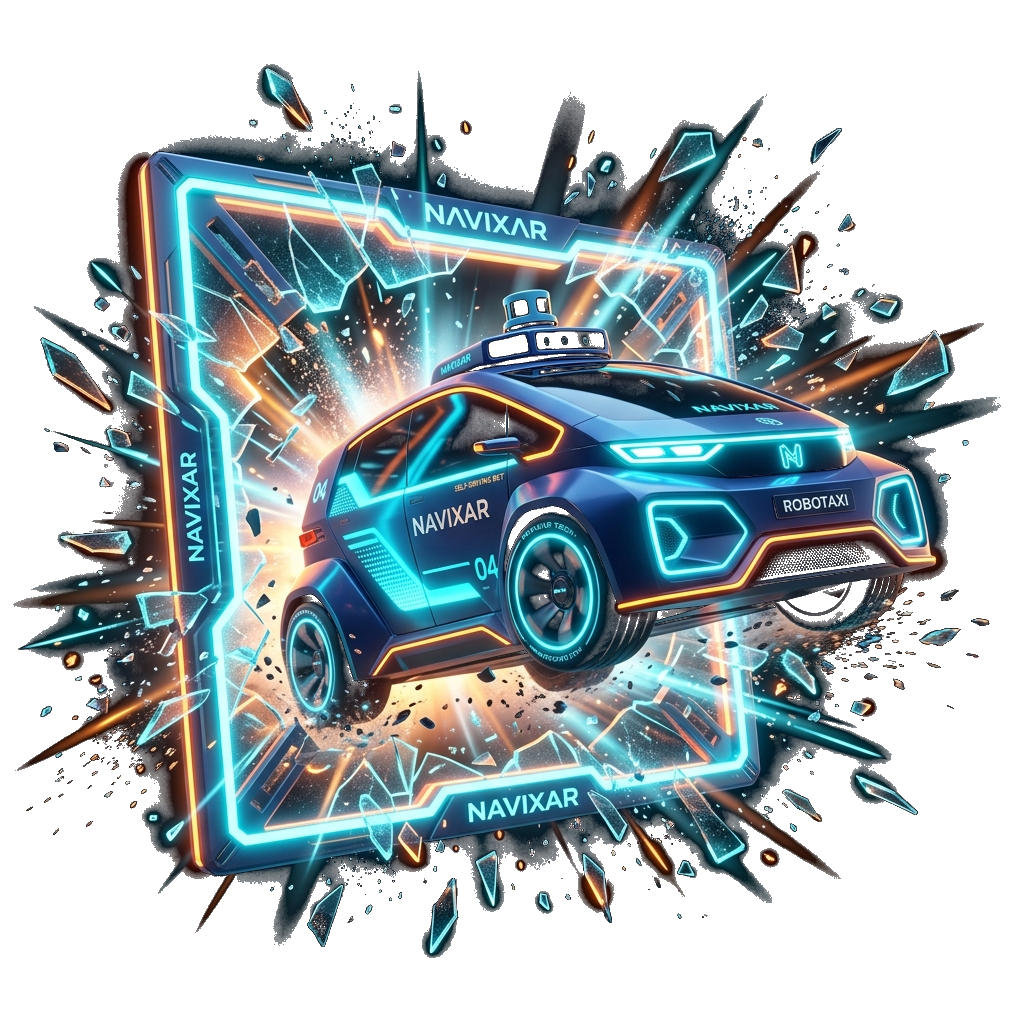
Gain Attention with an In-House Self Driving Robotaxi Bot

Deploying a physical in-house robotaxi bot creates unmatched real-world presence, viral brand attention, and immediate validation across Indian cities.

Robotaxi Bot Navixar Robotaxi Bot Crashing Out
04The Problem

The World Solved Autonomy For Everywhere Except India.

India's roads and traffic are unlike anywhere else, and no existing autonomous stack, dataset, or simulator was engineered to navigate them.
The Data Gap
99%

of AV training data is Western. A model trained on San Francisco cannot handle Saidapet: 40+ vehicle types, cattle, and lane-less chaos are entirely absent from global datasets.

Source: Crunchbase 2025
Simulation Gap
Broken

Existing simulators model structured lanes and western traffic with hand-built meshes. India's potholes, unmarked roads, and unstructured intersections do not exist in any current simulation stack.

Source: MoRTHS Gazette 2024
The Market Gap
β‚Ή0

India has 3M+ Ola/Uber rides per day, representing the world's ideal robotaxi culture, yet zero commercial autonomous vehicle deployments exist. The whitespace is total.

Source: Ola/Uber India 2025
05Gap 01 Β· Data

Let's Brake It Down.
Here's What Makes India Unique.

ΰ€‘ΰ₯‡ΰ€Ÿΰ€Ύ
99%
of all AV training data originates in the US or Europe. Indian roads are invisible to every major autonomous driving model on earth.
Western Training Data99%
India-Specific Data<1%
What Makes India Different
01
40+ Vehicle Classes
Two-wheelers, auto-rickshaws, cattle carts, and BEST buses all sharing a 4-metre lane.
02
Livestock and Unpredictable Actors
Cattle, pedestrians, and vendors mid-road are routine occurrences, not edge cases.
03
Road Surface Variability
Potholes, broken asphalt, flooded lanes, and unmarked speed bumps that no western dataset captures.
04
Zero Lane Discipline
Five vehicles wide on a two-lane road is standard. No model trained on SF can reason about this.
06Pillar 01 Β· Data Collection

We Will Innovate And Collect Data.

India runs on the world's largest digital public infrastructure: a billion smartphones, UPI, cheap data. Navixar leverages that to crowdsource and gamify data collection, because the goal isn't just kilometres. It's diversity: every vehicle type, every merge, every impossible intersection. Diversity in traffic is the dataset nobody else can build.
Remember PokΓ©mon Go?

Millions of Indians walked every street, alley, and corner of this country chasing PokΓ©mon β€” and every step fed mapping data to a foreign company building the world's most accurate maps. India already crowdsourced a country-scale dataset once. It just didn't own it. This time, the game is ours, the streets are ours, and the data stays ours.

AERIAL CAPTURE DETECTED DETECTED BLIND SPOT BLIND SPOT DETECTED NAVIXAR
2 vehicles undetected
The Navixar Data Pipeline
01
Drone-Based Aerial Capture
Drones flying above the vehicle see the dynamics ground sensors miss, such as two-wheelers, pedestrians, and near-misses within 2 metres of the car.
02
Gamified Traffic Challenges
Players build traffic challenges for each other inside splat-reconstructed Indian streets. Every attempt to solve one becomes labelled training data.
03
Dashcam Footage Acquisition
Buying existing dashcam footage at scale is the fastest, cheapest way to bootstrap millions of kilometres of real Indian driving before a single Navixar vehicle hits the road.
04
Owned Pipeline = Moat
Three independent sources feeding one proprietary dataset. Every kilometre anyone drives on foot, by drone, or on camera makes the model better and harder to copy.
The insight: You don't need a fleet to out-data everyone. Drones, dashcams, and a game get there faster and cheaper than a garage full of sensor-laden cars.
Same Dataset. Two Ways To Get There.
Traditional sensor fleet (Waymo playbook)~$20M+ per city Β· 3–5 years
Navixar crowdsourced pipeline<$1M Β· months, not years
Every rupee goes into diversity of traffic, not metal on wheels. A crowd of a million phones sees more of India in a month than a fleet of ten sensor cars sees in a decade.
Chai Walla
07Pillar 02 Β· Simulation

Gaussian Splats Make Large-Scale Validation Possible.

Mesh-based simulators approximate the world with hand-built polygons. Gaussian splats reconstruct it from real captured footage, keeping every pothole, glare, and reflection intact. That fidelity gap is what lets Navixar validate millions of scenarios before a single physical deployment.
Why Simulation-First Works
01
Infinite Scenarios
Millions of edge cases that would take decades to encounter on real Indian roads, all simulated at compute cost.
02
Orders of Magnitude Cheaper
One GPU cluster vs. a fleet of sensor-laden vehicles. Waymo spends $20M per car. Navixar spends compute.
03
Safe Iteration
Test sudden cattle crossings, brake failures, and flooded roads without any physical risk.
04
Validation At A Scale Roads Can't Match
Splat-based scenes are photoreal enough to trust the results. Every model update gets stress-tested against millions of Indian edge cases before a single real kilometre.
Mesh vs. Gaussian Splat
Mesh-Based Simulators (CARLA, Waymo Sim)
Hand-built polygons and textures. Structured US/European traffic, 4-way intersections, lane markings. Indian roads are invisible.
Mesh-Based Simulators (LGSVL, Apollo)
Chinese-road-optimised meshes. Misses Indian textures, pothole dynamics, and chaotic merges entirely.
Navixar's Gaussian Splat Engine
Reconstructed from real captured footage: actual potholes, actual glare, actual chaos. Validation on a splat scene is validation on the real road.
Loading Simulation
Processing Environmental Data...
Rendering structured lanes & basic polygons...
Move mouse to explore environment
08Our Solution Β· Simulation

The Simulation Environment Tailored for India

Current simulators focus on lanes and structured traffic. India brings challenges in roads, textures, and unknown objects that no existing tool handles.
Pillar 01
Road Fidelity

Pothole meshes, broken asphalt textures, flooded sections, and unmarked speed bumps. Every Indian road imperfection captured by drone and dashcam, then simulated with Gaussian splat rendering.

Gaussian Splat
Pillar 02
Traffic Chaos Engine

40+ vehicle types with behavioural models calibrated on Indian driving data. Lane-less merging, sudden cuts, pedestrians ignoring signals, livestock, and roadside vendors.

Stochastic Agent Modelling
Pillar 03
Gamified Data Flywheel

Users build and solve traffic challenges inside splat-based Indian environments as a game. Every decision becomes training data, generating scale without fleet infrastructure cost.

Crowdsourced Training Loop
Crowdsourced scale

The Gamified Training Loop

Instead of spending hundreds of millions on test drivers and fleets, Navixar gamifies the training process. Players create traffic challenges for each other to solve inside real, reconstructed Indian roads. Every maneuver, deceleration, and path choice feeds straight into our path planning AI.

Navixar Gamified Data Collection Mobile App Dashboard Mockup
09Why This Team

Built By Someone Who's Already Sold This To India's OEMs.

Data collection and processing isn't a hypothesis for Navixar's founder: it represents seven years of shipped work.

Munish Raj has spent seven years inside India's automotive data and simulation industry. Across OEM engagements, one thing has been consistent: data collection and processing is the easiest, most repeatable sell in the room. Every OEM needs it, and almost none can build it well in-house. Navixar takes that exact wedge and pushes it one notch further: from selling data as a service, to owning the full data-to-deployment stack.

7 Years
Inside The Industry

Seven years building data collection and simulation pipelines for automotive OEMs in India, the same buyers Navixar now sells a full autonomy stack to.

Domain Authority
10 Teams
aBaja SAE India

Rallied 10 student engineering teams to attack the automated-driving problem statement at aBaja: proof the problem is tractable with the right structure.

Grassroots Proof
SIH
Smart India Hackathon

Personally got Automated Driving added as an official Smart India Hackathon problem statement, placing the same problem in front of the country's entire engineering talent pipeline.

National Reach
10Why Now: The Evidence

The Robotaxi Race Just Went Global.
India Is The Exception.

Signals from across the industry over the last few months show that the race is accelerating everywhere but here.
A Governed Path Now Exists

The UN adopted the first binding global regulation for fully autonomous vehicles, effective January 2027, requiring mandatory simulation, testing, and safety-data recording for every signatory market.

Source: UNECE, 2026
Robotaxis Are Now Manufactured, Not Prototyped

Zoox unveiled a production-intent robotaxi with 100 vehicles/week manufacturing capacity. Waymo runs 3,000+ vehicles and ~500K paid rides a week across 10 US cities.

Source: Zoox Β· Waymo/NHTSA filings, 2026
The Unbundled Playbook Is Working

Bolt + Pony.ai + Stellantis launched a driverless "Living Lab" in Luxembourg; LOXO is running driver-out operations in Bern. Vehicle, AI brain, and demand network no longer need to be one company.

Source: Bolt Β· LOXO, 2026
Autonomy At Delivery Scale, Today

10,000+ driverless delivery vans now operate daily across China via Cainiao, DiDi, and Neolix, proving autonomous fleets already run at real operational scale.

Source: A3 Market Intelligence, 2026
Gaussian Splatting Is Becoming The Standard

NVIDIA's AlpaGym and NuRec, and Cesium's native splat streaming, are turning the exact simulation technique Navixar is built on into shared industry infrastructure.

Source: NVIDIA Β· Cesium, 2026
An OEM Insider Is Saying It Publicly

Maruti Suzuki's own Head of ADAS Testing says global playbooks don't automatically work on Indian roads, and calls for an India-first development strategy.

Source: LinkedIn, Head-ADAS Testing, Maruti Suzuki, 2026
ΰ€¬ΰ€Ύΰ€œΰ€Όΰ€Ύΰ€°
11The Market

India Is Moving. Fast.

3M+ daily rides, zero autonomous deployments. The market gap is absolute, and it is closing.
3M+
Ola/Uber rides per day in India
Source: Ola/Uber India 2025
β‚Ή0
Commercial AV deployments in India
Source: MoRTHS 2024
$21B
Global AV investment in Q1 2026 alone
Source: Crunchbase Q1 2026
Why India Is the Perfect Launch Market
+Highest ride-hailing density globally: demand is already proven
+Consumers already trust app-based transport for daily commutes
+Government actively building an AV testing and deployment framework
+Driver shortage gives autonomous vehicles a clear economic case
+If it works in India, it works in every emerging market on earth
The Competitive Moat
Waymo spent $3.5B with zero India presence. Mobileye and Baidu have global reach, but neither has India-native training data, local regulatory access, or a deployment roadmap for unstructured Indian traffic.
First-mover data advantage compounds. Every kilometre driven by drone, by dashcam, or by a player inside the game makes the model better for India, and only Navixar owns that data.
ΰ€¦ΰ₯ƒΰ€·ΰ₯ΰ€Ÿΰ€Ώ
12The Vision

In a Country Where Chaos Is Structural,
Robotaxis Will Prove There Is Order in Chaos.

Navixar is India's answer to the robotaxi revolution: the same technology the world is racing to build, tuned for Indian roads, opening multiple revenue streams from day one.
Revenue Streams
Robotaxi Fleet
Per-ride revenue. Partner with Ola/Uber or operate directly. 3M rides per day addressable from launch.
OEM Licensing
License the India-native AV stack to Tata, Mahindra, and Maruti, who have zero autonomous capability today.
Data Licensing
India road and traffic data is uniquely valuable. License to global AV companies building for emerging markets.
City and Government
Smart city initiatives, airport shuttles, last-mile connectivity under the MoRTHS AV framework.
Emerging Market Export
Southeast Asia, Africa, Latin America share India's unstructured road DNA. India success is the global playbook.
Simulation-as-a-Service
Lease access to the world's only India-specific unstructured traffic simulator. No substitute exists.
13Tailwinds

Here Is What Else Is Going for Us

The infrastructure is in place. The talent exists. The regulation is moving. The capital is arriving. We are timing this exactly right.
Existing ADAS Ecosystem

An underserved ADAS engineering community in India, with no domestic OEMs deploying at scale. World-class engineers exist. Navixar captures this talent at day-one cost.

Engineering Talent
Graduate Talent Surplus

IIT and NIT graduates specialising in robotics, AV, and AI, with nowhere to apply it in India. World-class technical talent at Indian salary scales.

Talent Pipeline
EV Supply Chain Investment

Tata, Ola Electric, and the FAME II subsidy scheme are building EV infrastructure at scale. AV-ready electric platforms will follow. Navixar rides this wave.

EV Infrastructure
Regulatory Tailwind

MoRTHS AV testing and deployment framework (2024 gazette notification). India is actively building the legal path for autonomous vehicle deployment on public roads.

MoRTHS Framework 2024
Deep Tech Capital Is Flooding In

India's deep tech startup funding is growing at its fastest pace ever, with investors actively hunting for hard-tech, India-first bets.

Deep Tech Wave
Built For India's AI Mission

India's national AI push isn't just about generic models. Autonomous driving for unstructured Indian roads is a flagship, India-only problem, solved with an India-first mindset.

India AI Alignment
Compute Only Gets Cheaper

GPU and edge-compute costs keep falling every quarter. A simulation-first, compute-heavy strategy gets more viable, not less, the longer this plays out.

Deployment Tailwind
14The Next 24 Months

From Raise To Road: Guess The Timeline.

Every phase de-risks the next. Data before simulation, simulation before models, models before metal. But how fast? For each milestone, guess when we hit it β€” then see the actual plan.
0 / 5 guessed
??
Close Pre-Seed Β· Assemble The Core

Founding team of 5 focusing on perception, simulation, and data engineering. First dashcam-footage acquisition partnerships signed. Drone capture pilots begin in one city corridor.

Foundation
Your guess:
??
1M+ km Of Indian Driving Data

Dashcam pipeline at scale, drone capture across 3 city corridors, gamified crowdsourcing loops live. First Gaussian-splat reconstructions of real Indian streets, forming the seed of the simulator.

Data Moat Begins
Your guess:
??
Simulation Engine v1 + Gamified Beta

Splat-based simulator running Indian chaos scenarios. Gamified data app in public beta, accelerating the crowdsourced flywheel.

Simulation Moat
Your guess:
??
India-Native Driving Model v1

First VLA policy trained on the proprietary Indian dataset, validated against millions of simulated scenarios. OEM pilot conversations formalised into an LOI.

Model Milestone
Your guess:
??
Closed-Course Demo β†’ Seed Round

Autonomous demonstration on a closed Indian course. MoRTHS testing application filed. Raise the seed on proof, not promise.

Proof Of Autonomy
Your guess:
15The Ask

Pre-Seed: $3.2M To Build The Moat.

SAFE instrument, targeting close in Q4 2026. Every dollar goes toward the assets nobody can copy: the dataset, the simulator, and the bot. This budget is interactive β€” flip the toggles, watch the total move, and see exactly what takes a hit.
Engineering Team Β· 3 years$1.0M
Perception, simulation, and VLA engineers from India's ADAS and robotics talent pool. Three full years of the only asset that builds everything else.
The Robotaxi Bot$150k
Battery pack, compute hardware, and an attention-grabbing bot India can't ignore. Pillar 03 made physical.
Model Training$500k
The VLA policy trained on the proprietary Indian dataset. The classic trade-off: rent the compute or own it.
Data Collection$500k
Cloud ingestion costs, drone permissions, and deploying the gamified crowdsourcing loops across Indian cities.
Simulator$500k
The Gaussian-splat simulation engine: India's chaos, reconstructed and replayable at validation scale.
Office, Legal & Misc Β· 2 years$100k
Office space, company setup, MoRTHS engagement, drone-operation compliance, and everything unglamorous that keeps the lights on.
Runway Buffer Β· 15% contingency$413k
Deep tech never ships on schedule. The buffer guarantees two full years of runway even when it doesn't.